
If your organization hasn’t begun succession planning, you may be gambling with its future. Succession planning is the strategic process of identifying and developing internal talent so employees are prepared to assume critical roles when others depart. It’s not the same as “replacement planning,” which is a short-term stopgap for emergencies. Done well, succession planning protects continuity, builds retention, and preserves institutional knowledge.
Why It Matters Now
The so-called “silver tsunami” isn’t theoretical anymore. Retirement has accelerated, and the talent pipeline won’t fix itself. A few data points:
- In June 2023, 44.9% of Canadians aged 60–64 and 80.5% of those aged 65–69 reported being partially or fully retired (Statistics Canada).
- Canada’s overall labour force participation rate is projected to stabilize around 65% through 2041 as the last boomers exit, even as the labour force grows from 21.7M (2023) to 26.8M (2041) (Statistics Canada analysis).
- Among Canadian SMEs, 62% are owned by people nearing retirement, yet only 8.5% have defined clear succession goals and 20.7% have not considered succession at all (MNP Succession Readiness Report).
- In the U.S., nearly two-thirds of family businesses lack a documented, communicated succession plan (Teamshares; see also Pew Research for the retirement surge context).
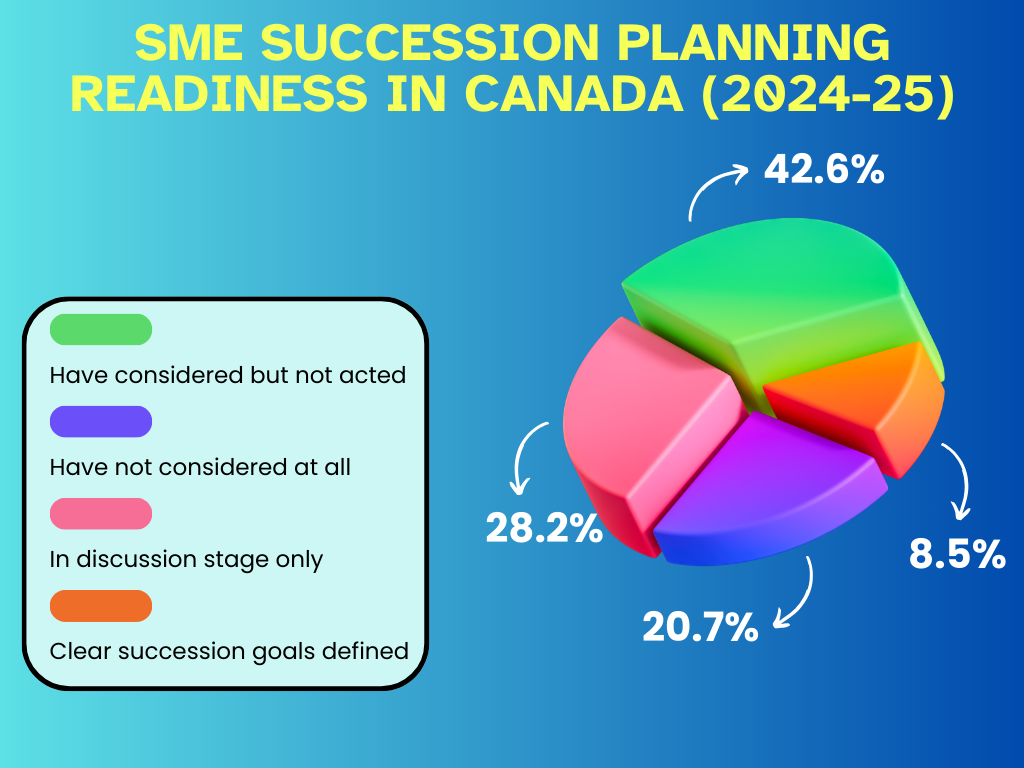 SME succession planning readiness in Canada (2024–25). Only 8.5% have clear goals; 20.7% have not considered succession at all.
Eight Practical Steps to Build a Succession Plan
1) Identify Key and At-Risk Roles
- Map roles most vulnerable to retirement, attrition, or burnout.
- Include technical experts, regulatory, client-facing and continuity-critical roles, not just executives.
- Use data: turnover, tenure, age distribution, performance stability.
2) Develop a Replacement Plan (Short-Term Coverage)
- Identify interim backups for sudden departures and emergencies.
- Communicate expectations and clarify that acting as a backup is not a guaranteed promotion.
3) Assess Bench Strength & Talent
- Run a skills, knowledge, abilities (SKA) assessment; use tools like a 9-Box (performance vs potential).
- Document SKA gaps for each role and each candidate.
- Weight potential and learning agility alongside current performance.
4) Close the Gaps with Targeted Development
- Create individual development plans tied to readiness levels (ready now, 1–2 years, 3+ years).
- Use stretch assignments, rotations, special projects, mentoring and coaching.
- Link development goals to performance reviews and quarterly check-ins.
5) Enable Knowledge Transfer
- Make tacit knowledge explicit through mentoring, storytelling, and shadowing.
- Curate explicit knowledge: process docs, manuals, SOPs, FAQs in a searchable repository.
- Cross-train teams so critical processes aren’t single-threaded through one person.
6) Build Mentoring & Shadowing Programs
- Pair high-potentials with leaders to accelerate exposure and close gaps.
- Formalize shadowing for priority roles; schedule handover windows before retirements.
7) Communicate Transparently
- Explain the purpose, process, and criteria; reduce rumor risk.
- Give regular updates in team meetings and 1:1s; separate development from promotion promises.
8) Evaluate, Re-Evaluate, Repeat
- Review succession coverage at least annually at the exec/board table.
- Track metrics that matter:
- Coverage: % of critical roles with ≥1 identified successor.
- Bench strength: successors “ready now” vs “ready in 1–2 years.”
- Internal fill rate for critical roles.
- Time-to-fill leadership positions.
- Update plans as strategy, technology, or market conditions change.
The Bottom Line
Succession planning isn’t an HR side project; it’s a survival strategy. The cost of delay shows up as knowledge drain, stalled initiatives, and chaotic backfills. The payoff shows up as smoother transitions, higher retention, and a leadership pipeline matched to your future strategy. Make it a standing item for leadership and the board.
If you are interested in having an expert on succession planning assist with your organization's implementation strategy, please reach out for more information